Showing posts with label architecture. Show all posts

Tuesday, March 8, 2011

Corner View - Wood

The wooden kampung house I lived in at the edge of the South China Sea, Terengganu

Wooden houses, Istanbul


Gol Stav wooden church, Norway


A wooden water wheel, Suwon, South Korea

Thursday, July 29, 2010

The Windmills of La Mancha


Ever since I read Don Quixote, I have wanted to see the windmills on the plains of La Mancha, and this summer I finally made it. Coming as I do from a country of small hills and valleys, vast plains have always seemed exotic to me, and one of the most pleasurable travel experiences of my life was driving across the Canadian Prairies. The plains of La Mancha are not quite on that scale, but they more than lived up to my expectations. When local wheat farmers switched over to wine production, the windmills, which once used to grind huge quantities of wheat, sadly became derelict, but now many of them are being renovated in the hope that they will attract tourists to this rarely visited area between Madrid and Andalusia. If you get the chance, go there, sample the Manchego cheese, ham and wine (La Mancha produces 50% of all Spain's wine and is now the most extensive wine-growing region in the world), but, above all, visit the beautiful windmills, the finest of which are near Consuegra and Campo de Criptana .

Tuesday, May 11, 2010

Top 10 Cities in the World - 10 Kiev


This is the first in a list of cities I have visited that I consider, for various reasons, to be among my Top 1o in the world. Beating off competition from Dubrovnik, Jogyakarta, Beijing, Ho Chi Minh City, Munich and Beirut:
NUMBER 10 - KIEV

Kiev is one of the grandest cities in Europe, but like most people, I was totally unaware of that until I saw it with my own eyes. From the late ninth century until the mid twelfth century, during the Golden Age, it was the capital of the Kievan Rus empire, and by the time of the Mongol invasion of 1240, it was one of the largest cities in the world.


Kiev has some of the world's greatest Christian buildings, including the UNESCO World Heritage Sites of St Sophia's Cathedral and the massive Pecherska Lavra monastery complex, which was founded nearly a thousand years ago, when the first cave chapels were excavated by Orthodox monks in the hills overlooking the River Dnieper. Kiev may also lay fair claim to being the city with the most beautiful women in the world, and you'll see more leggy, blonde 'supermodels' here than you'll see in a dozen Paris fashion weeks.

The best way to travel around the city is by Kiev Metro. which has the deepest underground stations in the world, and at times as you travel down the steep escalators you feel like you are on a journey to the centre of the earth.

Sunday, May 2, 2010

A Small Desert Town on the Silk Road


NA'IN

In 2001, I travelled around Iran, which is a truly fascinating country, inhabited by some of the friendliest people in the world. I went to the more obvious destinations, like Tehran, Isfahan and Shiraz, but I was also lucky enough to visit some of the smaller, less well-known caravan towns on the Silk Road, like Yazd and Na'in.


Na'in is a small town famous for its beautiful, blue and white carpets, which traditionally used indigo and silk brought by the camel trains returning from the Silk Road. In the middle is a two-thousand-year-old Sassanid Citadel, surrounded by a maze of alleyways, little changed since the Middle Ages. The town's tenth century adobe mosque, Masjid-e Jame, is one of the oldest in Iran.

All of the architecture in Na'in is designed to protect people from the baking heat of the desert sun. The traditional houses use wind towers to funnel the breeze through the interior. The rooms are below ground, where it is cooler.

If you like remote, exotic places, which the modern world has passed by, Na'in is for you.

Realistically, I will probably never return there, but back home in England, I have a beautiful Na'in carpet, which will always remind me of the town where it was made, and the people who made it.

The photos show a covered alleyway in the bazaar, a typical Na'in home with its rooms below ground, surmounted by a conical roof and wind towers, the crumbling Narin Ghaleh Citadel, where the inhabitants of Na'in used to flee to escape the invading Mongol hordes and, finally, the tenth century mosque.


Excuse the poor quality of the photos. They are grabbed frames from a tape on my old video camera.

Thursday, April 29, 2010

Art Deco v Art Nouveau - What's the difference? Part Two


ELIZABETES IELA 10b


PASAJUL MACCA-VILACROSSE


PART TWO - ART NOUVEAU

Art Nouveau is older and very different in style to Art Deco. It took its name from Samuel Bing's gallery, Maison de l'Art Nouveau, in Paris. In Central and Eastern Europe it is also known as Jugendstil or 'youth style'. One of its main influences was Japanese art, especially the woodcuts of Hokusai, and its main period was from the 1890s to the early 1900s, after Japanese prints appeared in Europe. It was especially popular in Northern Europe, with Latvia and Scotland being two of the countries with some of the finest examples of Art Nouveau architecture. It is characterized by non-geometric curves and swirls, and the facades of Art Nouveau buildings are usually decorated with floral designs, human figures and faces.

I have chosen two buildings to exemplify the style:

1/ Elizabetes iela 10b, Riga. Riga has over 750 Art Nouveau buildings, more than any other city in the world, and it was a visit there that got me really interested in this subject. The main reason is that one of the most prolific Art Nouveau architects, Mikhail Eisenstein (father of the film director Segei Eisenstein) lived there, and the building at Elizabetes iela 10b, built in 1903, is generally agreed to be his finest

2/ Pasajul Macca-Vilacrosse, Bucharest. This is a grand late nineteenth century, pedestrian thoroughfare, roofed with glass and wrought iron and lined with shops, cafes and restaurants. It has a typical Art Nouveau entrance, flanked by floral designs and human sculptures. It was designed by Catalan architect, Xavier Villacrosse, who studied in Paris. It is quite elegant and beautiful and when you see it, you will see why Bucharest was sometimes referred to as Little Paris.

PART ONE: ART DECO

Art Deco v Art Nouveau - What's the difference? Part One

EDIFICIO KAVANAGH

PALACIO SALVO

UNION HOTEL

When I travel, I usually take a guide book with me, and often come across references to Art Deco and Art Nouveau buildings, but to be quite honest I never really tried to find out what the difference was. I just knew that they both usually dated from the early twentieth century. However, after a recent trip to Riga, which has some of the finest examples of Art Nouveau architecture in the world, I finally started to get a grasp of what that was. It is quite a common style in big European cities. Art Deco, on the other hand, tends to be more prevalent in North and South America, with some of the finest examples being in New York.


PART ONE - ART DECO

Art Deco was a common style of design from the mid-1920s to the mid-1940s. It was intended to be elegant, sleek and modern. It took its name from the Internationales des Arts Décoratifs et Industriels Modernes held in Paris in 1925, but the term Art Deco was not widely used until it was popularized by art historian Bevis Hillier's 1968 book Art Deco of the 20s and 30s. So, how can you recognize it? Well, if you see a pre-war building with a streamlined look, then it's probably Art Deco. It is strongly influenced by the architecture of Ancient Egypt., with its pyramids and obelisks. If I tell you that the Empire State Building and Chrysler Building are Art Deco, then you'll start to form an image of what it looks like: tall and sleek, with geometric patterns and curves, sometimes with a sinister touch: think Superman and Gotham City. But, be warned, if it's got flowery designs and faces on the front, then it's more likely Art Nouveau.

In my opinion, Art Deco buildings can often be quite brutal and ugly, but here are three I've seen that I liked (photos from top to bottom):

1/ Edificio Kavanagh , Buenos Aires.
When it was completed in 1936, Edificio Kavanagh was, with a height of 120 m, the tallest building in Latin America and the tallest reinforced concrete building in the world. it was designed in a style which is a mixture of Art Deco and Modernism (that's another story), by architects Gregorio Sánchez, Ernesto Lagos and Luis Maria de la Torre. There is a funny story attached to this building: it was planned as an act of revenge by the developer, Corina Kavanagh. One of Corina's daughters had fallen in love with the son of the aristocratic Anchorena family, who lived in a palace and had built a church next to the site of the Kavanagh Building. The Anchorenas stopped the marriage to a member of a nouveau riche family, whom they perceived as being below their social status. So, to teach them a lesson they'd never be able to forget, Corina Kavanagh decided to build a skyscraper that would block the view of the church from their palace. It took all of her inheritance to complete it, and she spent the rest of her life living in an apartment on the 14th floor of Edificio Kavanagh. It is, nevertheless, a beautiful building, and it certainly has a 'wow' factor, because that's what I said when I first saw it.

2/ Palacio Salvo, Montevideo.
This 26-storey skyscraper, which dominates the skyline of Montevideo, was designed by the architect Mario Palanti, and constructed between 1925 and 1928. It is 95 metres high, but 100 metres with the antenna., and until the Edifico Kavanagh was completed eight years later, it was the tallest building in South America. Palacio Salvo may no longer be the tallest building in South America, but it is still the most popular image on postcards of Montevideo and remains a national icon for Uruguayans. I personally think it's one of the great pre-war skyscrapers, on a par with New York's Chrysler Building.

3/ Union Hotel, Bucharest.
Eastern European cities have many impressive Art Deco buildings from the 20s and 30s. One of the most spectacular is Bucharest's Union Hotel, which was built between 1929 and 1931 by local architect Arghir Culina. It used to be a hotel, but is now used as an office block.
 

PART TWO - ART NOUVEAU

Wednesday, March 24, 2010

Corner View - Traditional Architecture


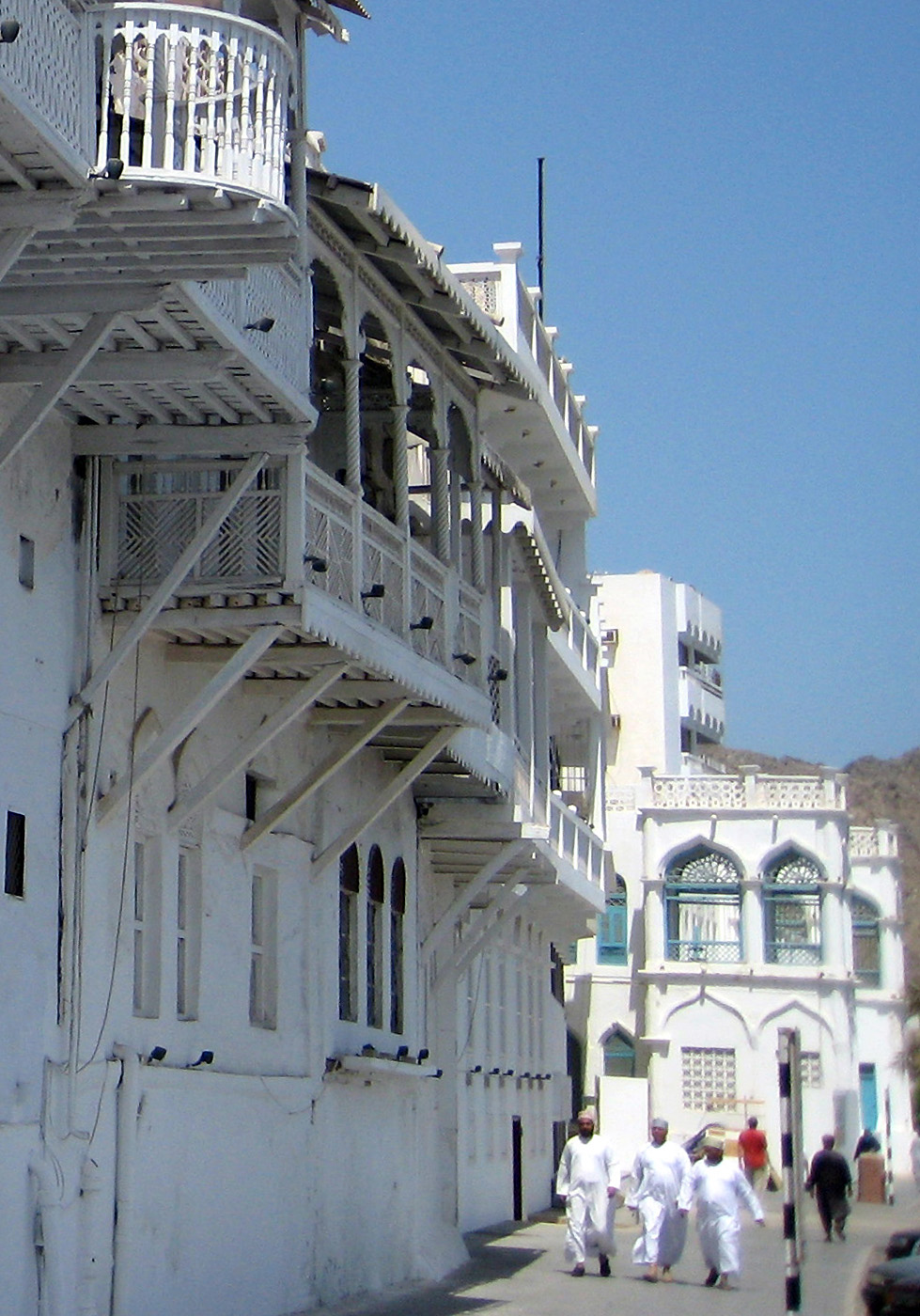
The photos show three examples of traditional Omani architecture. The first is the onion-domed tomb of Bin Ali, the second is of wooden-fronted merchants' houses on the harbourside at Muscat while the third is an adobe house at Mirbat, not far from Salalah.


Monday, October 19, 2009

The Fortified Granaries of North Africa


When I lived in Libya I had the opportunity to visit the beautiful fortified Berber granaries, which dot the northern fringes of the Sahara in Libya itself as well as in the neighbouring country of Tunisia. These qasrs, or ksars, are up to one thousand years old. They were used to protect food supplies from raiding parties.

The one featured in the first two pictures, Ksar Ouled Soltane, may look familiar to you, as it featured as slave quarters in one of the highest grossing movies of all time, Star Wars Episode I: The Phantom Menace.

The third photo is of the perfectly circular fort of Qasr al-Haj in Libya, which has been in continuous use by the Berbers for more than 800 years.

Tuesday, May 26, 2009

Corner View 7 Cityscapes

7


The theme for this week's Corner View is cityscapes. Oman's only real city, with a population of one million, is the capital, Muscat, so I've selected a few scenes from here. Muscat means 'anchorage' and it is actually a string of villages, forts, souks and mosques wedged into a narrow strip of land between the mountains and the sea. Some people say, it doesn't really have a city centre, but I would say the harbour area of Mutrah, featured in the photos, around which the city grew, is it's real centre. If you were expecting an ultra-modern city full of skyscrapers, like Dubai, Abu Dhabi, Doha or Manama, you'd be in a for a big surprise. Sultan Qaboos likes to conserve traditional Omani architecture, and any modern development is very strictly controlled.

Please visit the other Corner View bloggers for views of their cities:

jane, kim, ladybug-zen, ian, sunnymama, kyndale, samantha, karen, kristina, angelina, dorit, goldensunfamily, sophie, janet, nicki, ruth, mcgillicutty, desiree, di, travelingmama, aimee, bonnie, esti, sophie, cele, modsquad,caitlin, joyce, ani, couturecoucou, a day that is dessert, natsumi, epe, kaylovesvintage, trinsch, c.t.,jeannette, outi, schanett, ritva, dongdong, francesca, state of bliss, jennifer, dana, denise, cabrizette, bohemian girl, ruth, dianna, isabelle, amber, girl in the yellow shoes, mister e, janis, kari, jgy, jenna, skymring, elizabeth, audrey, allison, lise, cate, mon, victoria, crescent moon, erin, otli, amy, ida, caroline, lisa, dorte, kimmie, la lune dans le ciel, nicola, malo, vanessa, britta, virginia, april, rebecca, b

Tuesday, April 7, 2009

Pictures of Thula


In 2007 I worked in Yemen, a ruggedly beautiful country, and one of the few places left in the world where you actually feel you are going back in time to the Middle Ages and can see scenes straight out of the Tales of the Arabian Nights.


One of my favourite places there was the fortified town of Thula in the Haraz Mountains, where there is some magnificent, traditional architecture. Thula is an ancient city, named after Thula bin Lubakha Al-Hemiari, who lived here two thousand years ago.


There is a fortress on top of Al-Ghurab Mountain and a wall around the city, so you will enter it through one of the seven city gates. Its strong fortifications enabled it to repel the invading Ottoman Turks for more than three centuries. The houses of Thula are mostly 5 to 7 storeys high and have beautiful carved exteriors and colourful windows, known as qamereya

Amsterdam