Wednesday, May 19, 2010

Corner View - Collections


One disadvantage of leading a peripatetic life, is that you really can't take a lot of possessions with you. Right now, just about anything I've ever collected in my life is back at my house in England. Maybe it's just as well, as my prized collection of theatre, opera and concert programmes may have a lot of memories for me of great performances at New York's Met, Sydney Opera House, the Royal Opera House, Opera Bastille, and other great opera houses, concert halls and theatres around the globe, the occasions when I saw Luciano Pavarotti, Jose Carreras, Placido Domingo, Kiri Te Kanawa, Cecilia Bartoli, Montserrat Caballe, Marilyn Horne, Dietrich Fischer-Dieskau, Sir Simon Rattle, Claudio Abbado, Sir Georg Solti, Seiji Ozawa, Lorin Maazel, Andre Previn, Valery Gergiev, Daniel Barenboim, Alfred Brendel, Evgeny Kissin, Sviatoslav Richter, Martha Argerich, Itzhak Perlman, Isaac Stern, Maxim Vengerov, Yo-Yo Ma, Anne-Sophie Mutter, Mstislav Rostropovich, with the Berlin Philharmonic, Vienna Philharmonic, New York Philharmonic, Boston Symphony Orchestra, London Symphony Orchestra, Cleveland Orchestra, Royal Concertgebouw and all of the other great orchestras of the world, but I guess stacks of hundreds of programmes are not the most photogenic things in the world, especially as I keep them in three large suitcases.

So, instead you get a photo of my set of Chinese coasters, which is probably a lot more interesting!

Monday, May 17, 2010

Top 10 Cities in the World - 8 Shanghai


NUMBER 8 - SHANGHAI

Having been to China's big three cities of Beijing, Hong Kong and Shanghai, all of which might make my top ten, I opted for the latter. Shanghai is the most vibrant city in the world, and one day I can even see it taking over from New York as the world's unofficial capital city and economic centre.

Shanghai has a youthful population of 14 million, many of whom seem to be out walking on the streets, especially on the humid summer nights. It is a mix of old, like the Taoist temples, quite old, like the pre-war waterfront buildings on the Bund, new, like the dirty 1960s apartment blocks which cover much of the city, and ultra-modern, like the futuristic syscrapers sprouting up ever higher in Pudong to create a Chinese Manhattan in what was until recently farmland.

The city sprawls across the low-lying land of the Yangtze delta, with the Hunagpu River, a branch of the Yangtze, separating the Bund and the old city from the new city of Pudong on the east bank. The Bund is perhaps the most famous waterfront in the world and for many it is the classic image of Shanghai. The row of imposing Art Deco and Neo-Classical buildings on the west bank of the Huangpu constituted the administrative centre of what was for a time, in the 1920s and 30s, the busiest port in Asia. On warm summer nights, thousands of promenaders, many of whom, when I was there, seemed to selling fake Rolexes, throng the Bund, and take river cruises which offer spectacular views of the illuminated buildings. The way the city is booming, I'm sure it won't be long before those Rolexes are real ones like those worn in the chic, upmarket bars and restaurants of Xintiandi. The favourite destination for most foreign visitors, however is the Yuyuan temple gardens and bazaar. Built in 1559 during the reign of the Ming emperor Jiajing, it is famous for its classical Chinese architectural marvels, including the Big Rockery and the wonderfully named Hall of an Emerald Touch of Spring. As you wander round the gardens in summer, looking down at the golden carp in the ponds, the noise of the thousands of crickets in the bushes is deafening.


NUMBER 9 - MARRAKECH

NUMBER 10 - KIEV

Thursday, May 13, 2010

Top 10 Cities in the World - 9 Marrakech


NUMBER 9 - MARRAKECH

Marrakech is both ancient and exotic. If you are prepared for the fact that Marrakechis have 101 ways to relieve foreigners of their money, you can begin to enjoy the sights and sounds of 'The Pink City".

Marrakech was founded nearly a thousand years ago by Youssef ben Tachfine, the first leader of the great Almoravid dynasty, who conquered southern Spain for the Moors. His son, Ali ben Youssef, brought in the best architects and craftsmen from Cordoba to build a great capital city for his empire. In 1126 the city was fortified with walls around it. Then, between 1150 and 1199 the Koutoubia mosque, which you can see in the first photo, was built.

At the heart of the Old City is one of the biggest squares in the world, Djemaa el Fnaa, which although it means Assembly of the Dead in Arabic, is full of life, especially after sunset, when it has hundreds of food stalls, lit by lanterns, fresh orange juice sellers, musicians, dancers, acrobats, magicians, fortune tellers, henna artists and snake charmers, all plying their trades. Wander off the square and you will disappear into a maze of souqs.

It is a city that is not always easy on the eye, the ear or the pocket. No matter how well you speak French or Arabic, and no matter what that friendly carpet seller, who treats you like a long-lost brother, tells you, you will always be an outsider in Marrakech. When I pointed to the meter in a taxi, the driver shrugged, took another drag on his cigarette, and replied, as the smoke drifted past his No Smoking sign, "That's for local people". But, perhaps the fact that you will never feel at home in Marrakech, is what makes it so exotic.


Tuesday, May 11, 2010

Corner View - Statues


For this week's Corner View theme I am returning to my home country of England, to take a look at four iconic statues.

1/ The Water of Life, Chester.

Stephen Broadbent's bronze sculpture, the Water of Life, in Chester Cathedral's cloister garden, is one of the most beautiful in the world. Completed in 1994, it stands 3.3 m high, and depicts the encounter between Jesus and the woman of Samaria -a good Samaritan - who gave him water from a well, as recounted in John's gospel.

"Jesus said, 'But whosoever drinketh of the water that I shall give him shall never thirst; but the water that I shall give him shall be in him a well of water springing up into everlasting life." John 4:14.

2/ The Angel of the North, Gateshead.

Antony Gormley's massive Angel of the North is probably now the most famous statue in England. The steel sculpture was erected by the side of the A1 motorway, just outside the industrial town of Gateshead, in 1994. It is 20m tall, has a wingspan of 54m and is the largest sculpture of an angel in the world. Look closely at the photo and you will see the tiny human figures at its base.

3/ Robin Hood, Nottingham.

Robin Hood is Nottingham's main tourist attraction, and people come from all over the world to to see his statue, which stands in front of the walls of Nottingham Castle. James Woodford's statue of the legendary outlaw was given to the city by E.F. Clay in 1949. While I was taking this photo, a Japanese visitor told me that he had travelled half-way round the world just to be photographed standing next to it( lucky I was there!).

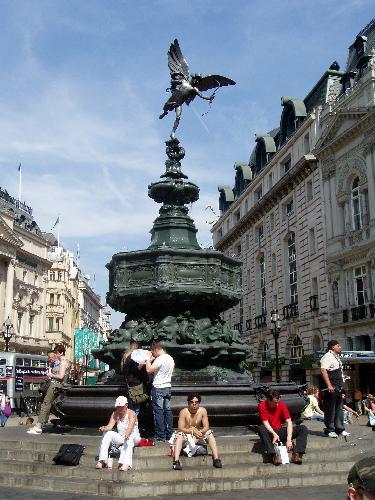
4/ Statue of Eros, London

Alfred Gilbert's Statue of Eros, which stands in the middle of Piccadilly Circus in London's Soho district was, until the Angel of the North was erected, the most iconic statue in England. Erected in 1892, it was the first statue in the world to be made of aluminium. In the Victorian era, the unveiling of a statue of a nude archer in the middle of what was to become London's red light district was somewhat contorversial, but now it is one of the favourite meeting places in the city. Although it is generally believed to represent Eros, Gilbert actually designed it to depict Eros's brother, Anteros, the God of requited love.

Top 10 Cities in the World - 10 Kiev


This is the first in a list of cities I have visited that I consider, for various reasons, to be among my Top 1o in the world. Beating off competition from Dubrovnik, Jogyakarta, Beijing, Ho Chi Minh City, Munich and Beirut:
NUMBER 10 - KIEV

Kiev is one of the grandest cities in Europe, but like most people, I was totally unaware of that until I saw it with my own eyes. From the late ninth century until the mid twelfth century, during the Golden Age, it was the capital of the Kievan Rus empire, and by the time of the Mongol invasion of 1240, it was one of the largest cities in the world.


Kiev has some of the world's greatest Christian buildings, including the UNESCO World Heritage Sites of St Sophia's Cathedral and the massive Pecherska Lavra monastery complex, which was founded nearly a thousand years ago, when the first cave chapels were excavated by Orthodox monks in the hills overlooking the River Dnieper. Kiev may also lay fair claim to being the city with the most beautiful women in the world, and you'll see more leggy, blonde 'supermodels' here than you'll see in a dozen Paris fashion weeks.

The best way to travel around the city is by Kiev Metro. which has the deepest underground stations in the world, and at times as you travel down the steep escalators you feel like you are on a journey to the centre of the earth.

Monday, May 10, 2010

La Antigua Guatemala


Now that I have achieved my ambition of visiting 100 countries (well, sort of - two of the countries no longer exist), I am building up to putting some top tens on my blog: top ten cities, paradises, archaeological sites etc. But, until then, here are some photos of one of my favourtie towns, Antigua La Guatemala. Built on the site of the Mayan city of Iximche, by Spanish conquistadores in 1543, it was the capital of Guatemala until it was destroyed by devastating earthquakes in 1773. It is now a UNESCO World Heritage Site and the number one travellers' town in Central America: you could say it's the Central American equivalent of Cuzco, full of hostels, language schools, restaurants and bars. There are some wonderful places to stay and eat here, including my favourite restaurant in Central America: La Escudilla, where you really should sit in the beautiful courtyard and try their Paradilla Quetzal. But, above all, there are the impressive colonial churches and monasteries which withstood the earthquakes. Surrounding the town, and giving it a magnifcent backdrop, are three smoking volcanoes, which remind you how fragile Antigua's existence is.

You might also like: The Country with the Highest Murder Rate in the World

Tuesday, May 4, 2010

Corner View - Gardens

JARDIN MAJORELLE, MARRAKECH

ROYAL BOTANICAL GARDENS, KANDY


The theme of this week's Corner View is actually 'garden', but I'm going to look at more than one, as here in Oman we have an unispiring back yard with a bit of bougainvillea, which attracts Sunbirds, African Silverbills and White-eyes, but it's not particularly photogenic. Back home in Hampshire, we have a house with a typical English garden, but as we only go back to take care of it for a few weeks each summer, it's beginning to go to rack and ruin. Probably, the most interesting garden I ever had was when I lived in a little whitewashed villa in Spain. It had orange and persimmon trees and grape vines, and I copied the locals by growing most of my own vegetables there. Can't find any photos of it though. You probably noticed there were a few 'buts' there, which all leads me to the fact that I'm not going to show you any of them. Instead I'm going to look at a few public gardens that have particularly impressed me in my travels around the world.

I like minimalist gardens, maybe because they are so different to what I grew up with in England, and I've always been attracted to the exotic. My favourite is the Zen Rock Garden at Ryoanji Temple in Kyoto. It consists simply of a rectangle filled with a bed of gravel and fifteen rocks. Laid out in the fifteenth century, it is regarded as a masterpiece of Japanese culture.

"That is a description, but to understand its effect, and its purity, you have to go there. The design generates tension, drawing the viewer to contemplate the mystery of Zen. It can't be photographed in entirety, the dimensions could drive any photographer to distraction, but thats the beauty of it. All you can do is just put the camera away, sit down and contemplate it. Especially when you realize that no matter where you sit, you will only see 14 of the rocks at any one time. The longer you sit, the more the garden fascinates." Japan Travel Guide. So, again, no photos, but it left a lasting impression on my mind, as I'm sure it will on yours when you go to see it for yourself. I expect some of you already have.

My second favourite is Jardin Majorelle in Marrakech. Currently owned by Yves Saint Laurent, it was originally laid out by another Frenchman, Jacques Majorelle, in 1886. Like the Ryoanji rock garden, it is a place that inspires contemplation and wonder, although I'm sure that some visitors must walk round it once, which can be done in less than five minutes, and ask, 'Is that it?' The garden is indeed small and simple, but the cacti and palm trees are set off to perfection by the blue architecture. This time there are photos, but they don't really do it justice. Again, you should go to Marrakech and see it for yourself one day.

Third place must be shared by a number of botanical gardens which feature collections of rare and exotic plants and trees collected by Victorian botanists , including Kew Gardens in London and the Royal Botanical gardens of Calcutta and Kandy, the last of which is featured in the photos. They are vestiges of a lost empire, and, like my garden in England, many of them, especially the one in Calcutta, are becoming ovegrown and going to rack and ruin. The great Mughal Shalimar gardens on the shores of Dal lake in Kashmir have been abandoned and neglected for even longer, but you can still conjure up visions of their lost beauty as you drift by them in a shikara .

Do you remember that children's book by Frances Hodgson Burnett, The Secret Garden? There is something intriguing about the idea of being able to enter a long-lost secret garden, isn't there?

Amsterdam